Unknown's avatar

Posts by dilanshah

Embrace Paradox.

Reblog: Doob 3D-High Fidelity Partnership Promo: First 100 Scans Free

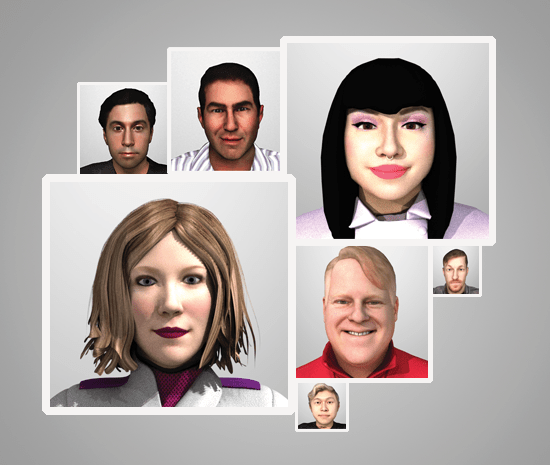
Today, High Fidelity and doob™ announce a partnership to enable the importing of doob™ full body scans into High Fidelity virtual reality environments as fully-rigged user avatars.

I myself have made an appointment and will post later on how my model comes out by uploading it to Sketchfab with a high likelihood.

from Pocket

via Did you enjoy this article? Then read the full version from the author’s website.

Reblog: Refining Images using Convolutional Neural Networks (CNN) as Proxies by Jasmine L. Collins

For my Machine Learning class project, I decided to look at whether or not we can refine images by using techniques for visualizing what a Convolutional Neural Network (CNN) trained on an image recognition task has learned.

from Pocket

via Did you enjoy this article? Then read the full version from the author’s website.

Reblog: Football: A deep dive into the tech and data behind the best players in the world

S.L. Benfica—Portugal’s top football team and one of the best teams in the world—makes as much money from carefully nurturing, training, and selling players as actually playing football.

Football teams have always sold and traded players, of course, but Sport Lisboa e Benfica has turned it into an art form: buying young talent; using advanced technology, data science, and training to improve their health and performance; and then selling them for tens of millions of pounds—sometimes as much as 10 or 20 times the original fee.

Let me give you a few examples. Benfica signed 17-year-old Jan Oblak in 2010 for €1.7 million; in 2014, as he blossomed into one of the best goalies in the world, Atlético Madrid picked him up for a cool €16 million. In 2007 David Luiz joined Benfica for €1.5 million; just four years later, Luiz was traded to Chelsea for €25 million and player Nemanja Matic. Then, three years after that, Matic returned to Chelsea for another €25 million. All told, S.L. Benfica raised more than £270 million (€320m) from player transfers over the last six years.

At Benfica’s Caixa Futebol Campus there are seven grass pitches, two artificial fields, an indoor test lab, and accommodation for 65 youth team members. With three top-level football teams (SL Benfica, SL Benfica B, and SL Benfica Juniors) and other youth levels below that, there are over 100 players actively training at the campus—and almost every aspect of their lives is tracked, analyzed, and improved by technology. How much they eat and sleep, how fast they run, tire, and recover, their mental health—everything is ingested into a giant data lake.

With machine learning and predictive analytics running on Microsoft Azure, combined with Benfica’s expert data scientists and the learned experience of the trainers, each player receives a personalized training regime where weaknesses are ironed out, strengths enhanced, and the chance of injury significantly reduced.

Sensors, lots of sensors

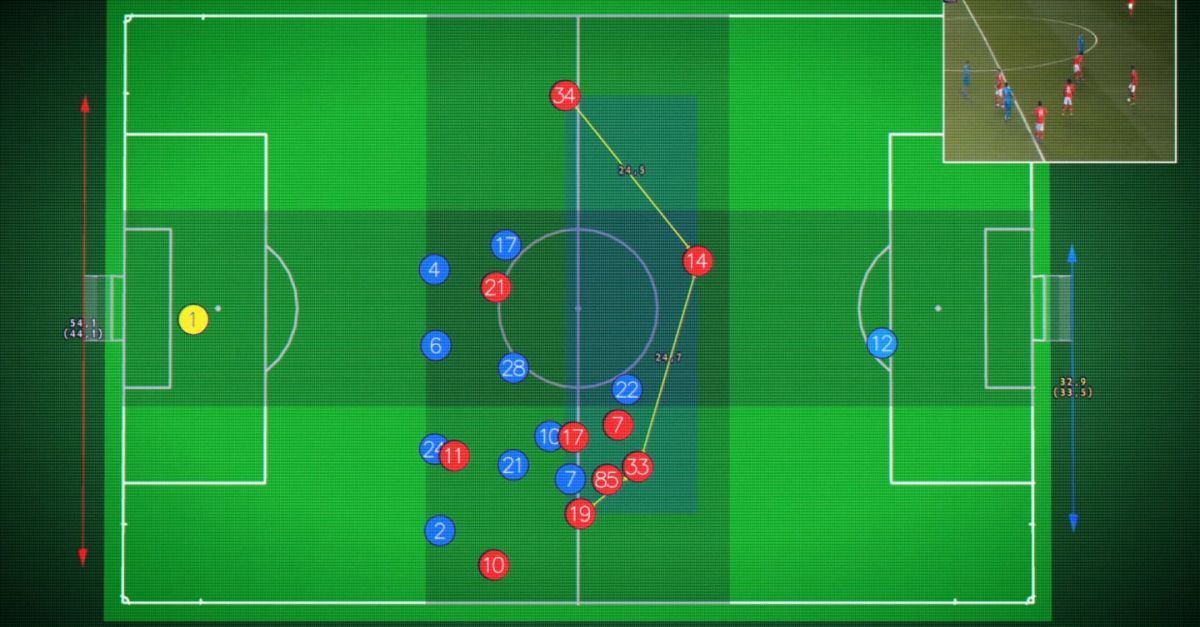
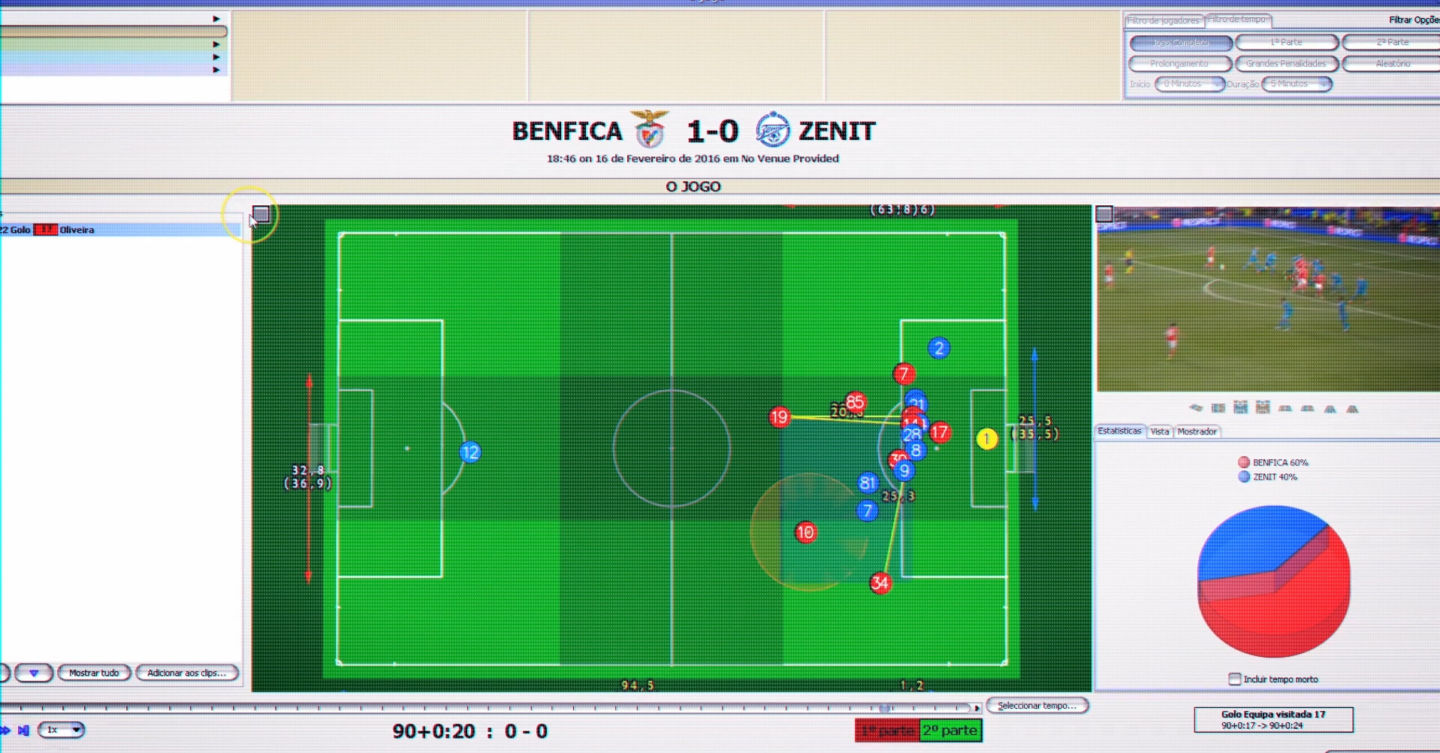
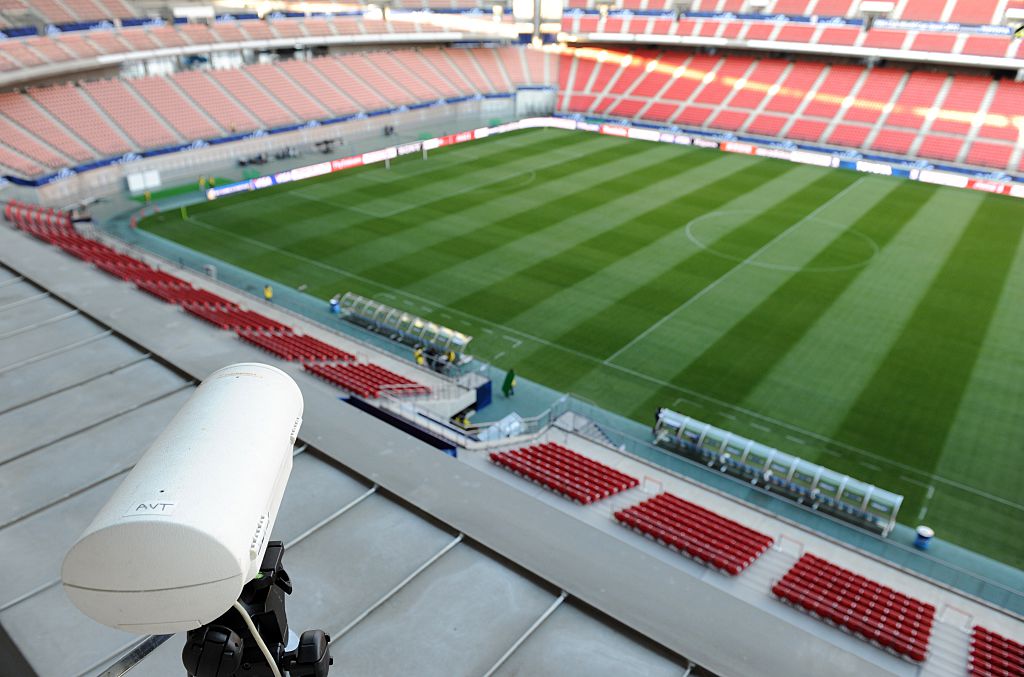
Before any kind of analysis can occur, Benfica has to gather lots and lots of data—mostly from sensors, but some data points (psychology, diet) have to be surveyed manually. Because small, low-power sensors are a relatively new area with lots of competition, there’s very little standardization to speak of: every sensor (or sensor system) uses its own wireless protocol or file format. “Hundreds of thousands” of data points are collected from a single match or training session.

Processing all of that data wouldn’t be so bad if there were just three or four different sensors, but we counted almost a dozen disparate systems—Datatrax for match day tracking, Prozone, Philips Actiware biosensors, StatSports GPS tracking, OptoGait gait analysis, Biodex physiotherapy machines, the list goes on—and each one outputs data in a different format, or has to be connected to its own proprietary base station.

Benfica uses a custom middleware layer that sanitises the output from each sensor into a single format (yes, XKCD 927 is in full force here). The sanitised data is then ingested into a giant SQL data lake hosted on the team’s own data centre. There might even be

Joao Copeto, chief information officer of S.L. Benfica.

a few Excel spreadsheets along the way, Benfica’s chief information officer Joao Copeto tells Ars—”they exist in every club,” he says with a laugh—but they are in the process of moving everything to the cloud with Dynamics 365 and Microsoft Azure.

Once everything is floating around in the data lake, maintaining the security and privacy of that data is very important. “Access to the data is segregated, to protect confidentiality,” says Copeto. “Detailed information is only available to a very restricted group of professionals.” Benfica’s data scientists, which are mostly interested in patterns in the data, only have access to anonymised player data—they can see the player’s position, but not much else.

Players have full access to their own data, which they can compare to team or position averages, to see how they’re doing in the grand scheme of things. Benfica is very careful to comply with existing EU data protection laws and is ready to embrace the even-more-stringent General Data Protection Regulation (GPDR) when it comes into force in 2018.

via Did you enjoy this article? Then read the full version from the author’s website.

Reblog: Life-like realism, a Pixel AR and going mainstream: catching up with Project Tango

Project Tango has been around for a while, from the developer tablet and demos at MWC and Google I/O to the Lenovo Phab2 Pro and the new Asus Zenfone AR. While we’ve seen it progress quite steadily in that time, we’ve never seen it look as convincing as it did at I/O this week.

from Pocket

via Did you enjoy this article? Then read the full version from the author’s website.

Reblog: Using Machine Learning to Explore Neural Network Architecture

At Google, we have successfully applied deep learning models to many applications, from image recognition to speech recognition to machine translation. Typically, our machine learning models are painstakingly designed by a team of engineers and scientists. This process of manually designing machine learning models is difficult because the search space of all possible models can be combinatorially large — a typical 10-layer network can have ~1010 candidate networks! For this reason, the process of designing networks often takes a significant amount of time and experimentation by those with significant machine learning expertise.

Our GoogleNet architecture. Design of this network required many years of careful experimentation and refinement from initial versions of convolutional architectures.

To make this process of designing machine learning models much more accessible, we’ve been exploring ways to automate the design of machine learning models. Among many algorithms we’ve studied, evolutionary algorithms [1] and reinforcement learning algorithms [2] have shown great promise. But in this blog post, we’ll focus on our reinforcement learning approach and the early results we’ve gotten so far.

In our approach (which we call “AutoML”), a controller neural net can propose a “child” model architecture, which can then be trained and evaluated for quality on a particular task. That feedback is then used to inform the controller how to improve its proposals for the next round. We repeat this process thousands of times — generating new architectures, testing them, and giving that feedback to the controller to learn from. Eventually, the controller learns to assign a high probability to areas of architecture space that achieve better accuracy on a held-out validation dataset, and low probability to areas of architecture space that score poorly. Here’s what the process looks like:

We’ve applied this approach to two heavily benchmarked datasets in deep learning: image recognition with CIFAR-10 and language modeling with Penn Treebank.

from Pocket

via Did you enjoy this article? Then read the full version from the author’s website.

Musings about when and how this research might manifest in human products are welcome. Tweet to me @dilan_shah.

Reblog: Why Voxels Are the Future of Video Games, VR, and Simulating Reality

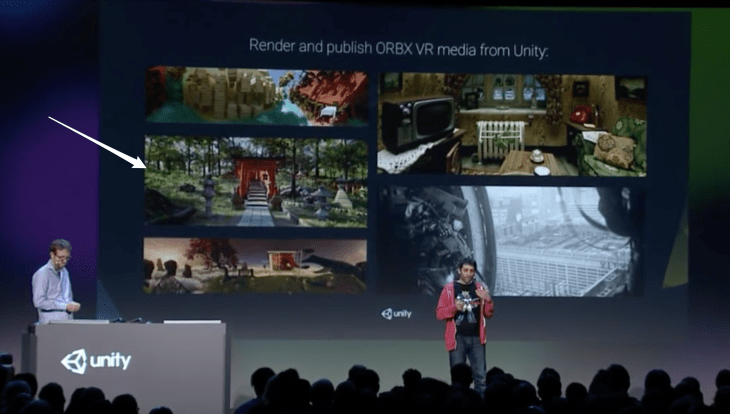
At VRLA this past month, I had the opportunity to see first-hand how the technology gap is closing in terms of photorealistic rendering in virtual reality. Using the ODG R-9 Smartglasses, Otoy was showing a CG scene rendered using Octane Renderer that was so realistic I couldn’t tell whether or not it was real. The ORBX VR media file that results when you build a scene using Octane can be played back at 18K on the GearVR. Unity and Otoy are actively working to integrate their rendering pipeline in the Unity2017 release of the engine. And in short, with a light-field render option, you can move your head around if the device’s positional tracking allows for it.

Screen_Shot_2017-05-08_at_4_08_29_PM.png

Octane is an unbiased renderer. In computer graphics, unbiased rendering is a method of rendering that does not introduce systematic errors or distortions in the estimation of illumination. Octane became a pipeline mainly used for visualization work, everything from a tree to a building for architects, in the early 2010s. About 13 years ago, Sony Pictures Imageworks enabled VFX knowledge that is coming to VR content from Magnopus. How VR, AR, & MR Are Driving True Pipeline Convergence, Presented by Foundry

change of pace with the voxel, so named as a shortened form of “volume element”, is kind of like an atom. It represents a value on a regular grid in three-dimensional space.

This is analogous to a texel, which represents 2D image data in a bitmap (which is sometimes referred to as a pixmap). As with pixels in a bitmap, voxels themselves do not typically have their position (their coordinates) explicitly encoded along with their values. Instead, the position of a voxel is inferred based upon its position relative to other voxels (i.e., its position in the data structure that makes up a single volumetric image). In contrast to pixels and voxels, points and polygons are often explicitly represented by the coordinates of their vertices. A direct consequence of this difference is that polygons are able to efficiently represent simple 3D structures with lots of empty or homogeneously filled space, while voxels are good at representing regularly sampled spaces that are non-homogeneously filled. [1]

Within the last year, I’ve seen Google’s Tango launch in the Lenovo Phab 2 Pro (and soon the Asus ZenFone AR), Improbable’s SpatialOS Demo Live, Otoy’s ODG R-9’s at Otoy’s booth at VRLA of an incredibly realistic scene completely rendered using some form of point cloud data.

“The ability to more accurately model reality in this manner should come as no surprise, given that reality is also voxel based. The difference being that our voxels are exceedingly small, and we call them subatomic particles.”

[1] Wikipedia : Voxel
from Pocket

via Did you enjoy this article? Then read the full version from the author’s website.

Unpackaging: 360˚ Video and Real-time CG Elements Compositing in Unity

At Unity Vision Summit a couple days ago, Unity announced that 360˚ video compositing will be available in “Unity2017”. Unity2017 is the next stable release of their engine, said to focus on artists and designers.

With this new feature in Unity engine, anyone can add graphics effects such as lens flares, digital animations, and interactivity in real-time to a video. The presenter Natalie Grant, a Senior Product Marketing Manager @Unity of VR/AR/Film, said one of the most important aspects about VR is that it achieves the “feeling like you are actually there.” She continued, “These are a few small ways to make a regular 360˚ video interactive and immersive”.

The purpose of this post is to explain that I posit that consumers and creators alike will learn more about computer graphics topics like (General Purpose GPU usage) and virtualization of the real-world. WebVR and 360˚ content on laptops and phones will “bring people up the immersion curve” as Mike Schroepfer says. This approach where content is composed of 360˚ video and real-time 3D model content will contribute to that.


What is compositing?

Compositing is combining of visual elements from separate sources into single images.

How it’s achieved in Unity with 360˚ videos

As described in the talk*, 360˚ composited with real-time CG elements is essentially two spheres in a scene and 360˚ videos on the interior of each sphere with a camera at the shared center point. To explain, imagine the layers of the Earth as an analogy.

earth_analog

The inner core is essentially the user’s head or main camera looking around the environment. The outer core is the first 360˚ video player with a shader** applied to it masking some of the video but not all of it. Skipping the lower mantle temporarily, the upper mantle is where the second 360˚ video player is. This upper mantle is showing the same 360˚ video as the inner player but normally, without a shader. In between, the lower mantle is where users can now place digital animations, 3D objects, and UI elements that are interactable. This is where all the magic happens–specifically because the space between the two concentric 360˚ video player spheres allows for CG content to really seem in the scene. Both copies of the composited 360˚ video are exactly in alignment–meaning that as long as the user’s view position is confined to 3DoF, the user can’t tell there are two copies of this video file playing when viewing this.

Finally, for more immersion, the Crust and the rest of Space, is also a layer where any Unity object can be positioned.

Natalie shows this is important in the use case of matching a Unity directional light source to the position, direction, and intensity of the sun as captured in a 360˚ video. This means that because of Unity’s physics based rendering, the CG elements (in the lower mantle or outer crust with standard shaders) should have shadows, color, reflections and more produced in a realistic way (because they are affected by the light source). This increases the effectiveness of the illusion that footage and real-time elements are composited.

Another way to think about this approach is as the Russian nesting dolls of spheres (credit: Ann Greenberg). In this comparison, each doll corresponds to a 360˚ video sphere, and just like the dolls, the spheres are concentrically nested and aligned with the same rotation.

russiandolls

As demonstrated by Natalie on stage, when done deliberately enough the 3D content will actually look like it’s in the camera-captured shot. Creating the illusion that 3D objects are occluded or hidden behind the inner sphere playing video (see below a 3D dinosaur moving behind the first 360 video).

ujyxCC.gif

In the short-term, I think this will help people engage with more 360˚ video content and potentially excite people about mixing camera captures and virtual content.


When demonstrating “locomotion in 360˚ video”, Natalie Grant of Unity showed that one can click to move to another 360˚ video. For starters, this isn’t exactly like movement with teleportation in a completely digital environment, where one can teleport anywhere a pointer collides with a plane. Remember that the creative behind the project must capture each 360˚ video using a camera and tripod, and that’s still a constraint on the freedom of choice for location. However, with potentially a lot less work, the creative can begin making compelling 360˚ video experiences with an interactive component (i.e. switching the 360˚ video) and layers of spatially accurate CG objects.

Also at this year’s F8 developer conference Facebook announced a new camera, the Surround 360 video camera, that will let users move around inside live-action scenes. The product can infer 3D point and vector data of its surroundings using overlapping video image data from adjacent cameras. So a reasonable implication is that we may even have 6 DoF live action scenes eventually with CG elements composited***.

However, I’d imagine that blind spots would exist once a user has moved significantly from the original center of the two spheres, and that will also impact the integrity of the illusion that both CG and video are composited.


I look forward to seeing some creative applications of this method.

*found at the 35-minute mark https://www.youtube.com/watch?v=ODXMhaNIF5E

** A Unity Standard Shader attempts to light objects in a “physically-accurate” way. This technique is called Physically-Based Rendering or PBR for short. Instead of defining how an object looks in one lighting environment, one needs only to specify the properties of the object (e.g. how metal or plastic it is).

Then, the shader computes its shading based on those factors.

***The original Surround 360 was estimated to cost about $30,000 at using the company’s exact schematics.

Virtual Virtual Reality


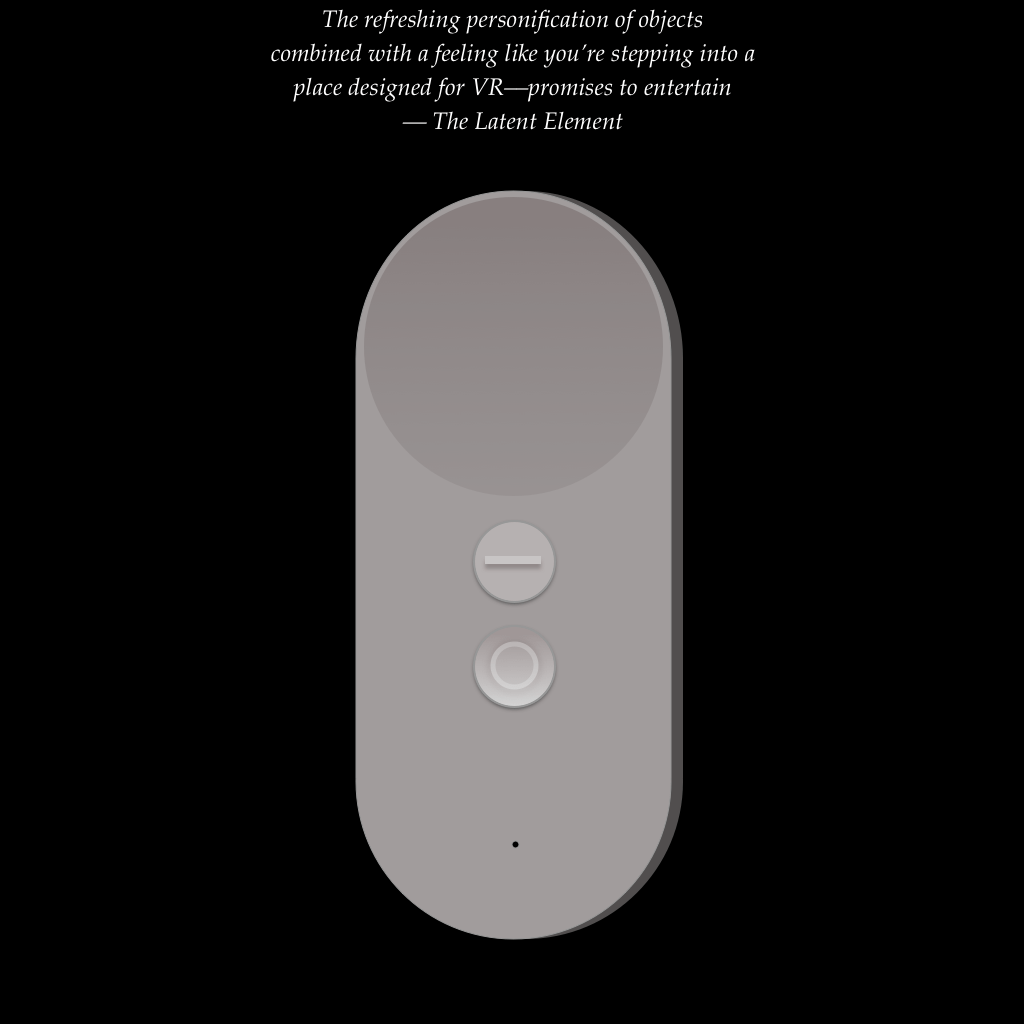
daydream-controller-1-the-latent-element.png# Virtual Virtual Reality

Created by the Ingenious Minds of Tender Claws

In Virtual Virtual Reality the setting is Activitude, where you play the role of a human trying to appease various “A.I.” characters. These characters end up being personified objects like a brick of butter, tumbleweed, or sailboat.

You will quickly be shown the button layout by the host, who calls you Bee. Your duties each take place in separate “virtual labor access points” which are really virtual realities within virtual reality and to enter and exit you will put VR headsets to your face using the Daydream Controller. Ipso facto, you will peel these headsets off to exit different virtual realities. As you begin your duties––chores that seem unmanageable, even by the most dexterous Daydream users standards––you are subjected to funny, quirky characters’ demands.

Progress will reveal that the virtual realities are holographic projections absconding a larger scheme…

Perhaps what I liked most about it was its design.

For the first time in a long while, I was given a reminder that we can create completely surreal worlds for users. Later on, I was on a train in Shanghai and looking down the train as we moved through turns the train cars reminded me of the vertebrae of a spine or something…

IMG_20170313_121843.jpg

I thought it’s almost like being inside of a snake. This immediately became food for thought for a VR piece–climbing into a snake as a mode of transportation.


Virtual Virtual Reality is designed for longer sessions (you can spend nearly half an hour
in the app) affording you the ability to try many things and headsets on without exhausting all possibilities. It follows, of course, that the app and daydream are super comfortable, thoughtfully crafted so you don’t need to view behind you that much. Tender Claws also made fantastic use of the controller and defined a mechanic that harks back to
Portal.

Teleportation is great with the application button and uses vectors to illustrate a warping effect.

I’m left wanting to play more. The character voice-overs, spatial audio, and sense of humor are especially notable.

Three Trending VR Topics from GDC and Unity Updates

Three Trending VR Topics from GDC

The following is a synthesis of a talk given by Greenlight Insight’s Alexis Macklin and Unity’s Tony Parisi along with my own experiences at Oculus Developer Day 2017. The notes on VR experiences are important as the industry grows because we can reflect on what strategies are yielding better experiences for our users.

1) Complex Story-Telling

Dear Angelica and Why it Was Ground-Breaking

  • Creators at Oculus Story Studio used a combination of Houdini (cinema), UE4 (games), and Quill (art)
  • Use of Houdini in the flow of VR development is also illustrated really well by Mike Murdoc, Creative Director at Trihelix VR
  • Mike uses Houdini to permute and design VR interfaces check out what I mean.

2) Locomotion

  • Design Standards Don’t Exist Yet The style of teleportation or varieties of movement that are considered correct are still just beginning to be explored and developed––don’t expect to see a consensus on a design strategy
  • An indicator of Motion Sickness Many VR developers identified however that movement in the user’s peripheral vision is a good indicator of motion sickness. So if the user was teleporting from point A to point B and that user saw something moving in the corner of his or her eye that is a scenario you can expect will yield some sickness. This is controllable, outside of individual tolerances
  • Accessibility How to bring VR to those that can’t use VR right now, was a big theme. Different control schemes are to be developed throughout the year

3) Social VR Experiences

  • Sony VR bringing games and multiplayer activities to users. Eye and mouth movements are said to evoke the most emotional appeal out of the users. Do not approach the uncanny valley––in short, this means to stick to surrealism and cartoony type of avatars––the best way I can explain this is with Bitmoji. If you have created one of them, you probably understand, that they are not created to look exactly like you. They are an abstract that might share a similar skin tone to you or a similar clothing style; and, it’s intentionally just enough to create resemblance and purposefully doesn’t go too close to your real image.
  • Simply put, it can become a little messy as your brain develops a picture around all of the minute details that might be wrong about the representation as opposed to a clearly abstract example of a person

Examples

Robo Recall by Epic Games

  • Subject: Similar to Destiny or Call of Duty––stop bad guys
  • Lacked an overarching plot intentionally
  • Users are forced to explore new interactions and environments
  • Hopes to have longer play times Stevi Rex and Alexis both note that for them it’s the first VR title that left them wanting to play more

Sprint Vector by Survios

  • Subject: Run as fast as you can at top speeds to reach the finish line
  • Previously released Raw Data (made $1 million in a month)
  • Throws locomotion standards out of the window and asks you to swing your arms with tracked controllers as if you were on an elliptical machine
  • A lot of people were expecting motion sickness but so far, there has been positive reviews
  • Many many videos of people racing can be found online

Bebylon by Kite and Lightning

  • Subject: Futuristic baby battles
  • Currently, this is in a closed beta
  • 2 different levels of social interaction one is amongst other players and another amongst spectators––it is cross-platform
    • PC VR
    • Mobile VR
    • Console VR
    • Youtube (includes spectator-mode)
    • Twitch (includes spectator-mode)

From Other Suns by Gunfire Games

  • Subject: A four-player RTS in which you fight and try to save humanity
  • A unique movement mechanic combines stepped teleportation with a switch from first-person–you are your character–to third-person–you are controlling your character–to guide your character to his or her next location
  • They have also employed accessibility well so you can choose to opt out of the aforementioned mode of transportation if you’re more comfortable with VR
  • Finally, comfort turning is displayed well in the app–this is where the player can rotate at no less than a 20-degree angle increment.
  • Oculus is the publisher for this title

Brass Tactics by Hidden Path Entertainment

  • Subject: A real-time strategy game that asks you to engage your enemy and conquer territories
  • Most notable perhaps is the paint-brush-stroke-like style that you are encouraged to corral your troops and send them to other territories with the Oculus Touch controllers
  • This is a social app as well, and you can see your opponent across the expanse of the game board in front of you
  • I felt an awesome thrill and palpable sensation of pressure to guard my already captured territories before the game clock ran out–which is undoubtedly because of the fact that you have another player in view

Unity Updates – featuring Tony Parisi, Global Head of VR/AR @ Unity

At the end of the month Unity 5.6 will be released

  • Physics-based rendering and lighting––yielding much more realism
  • Significant optimization and latency reduction with single-pass rendering for mobile
  • Vulcan Support with Unity 5.6

It’s clear that Unity brings a lot of different toolsets together… namely, the gaming and cinematic arts sectors seem to be bridged by Unity

How can those individuals working on VR––coming from Animator and Photo-capture backgrounds––use Unity to optimize their VR experiences and would you please share a few successful examples?

  • Unity is super excited about the cinematic use of Unity for storytelling, that isn’t about leveling up or gaining points. Rather, you have environments where you can explore and video game technology is used to tell stories.
  • This also ties into Unity’s big focus on enabling designers and artists more in the year 2017–as Unity has been more of a programmer’s tool. Coming to the beta of Unity 2017 (will be in beta later this year), there is a feature called Timeline which is all about a keyframe and timeline based animation system in which you can bring in keyframe 3d graphics, skin characters, audio, and video, and even synchronize them all in a linear timeline.

Now there’s a video player that supports 360-degree playback. Also supported is 4K video playback, ingest a 360-degree video and then augment that video for enhanced viewing.

Non-Gaming Examples #MadeWithUnity

Asteroids by Baobab

  • Asteroids is a follow-up to their popular “Invasion” (you can find Invasion on Daydream and GearVR). It’s Pixar quality, looks like a feature film quality piece. They have some novel locomotion mechanics, and you play a supporting character where you have to participate to move the story along. A great full, end to end, narrative where there’s only one way the story ends.

A Price of Freedom by Construct Studios

  • You play a secret agent, inspired by the MK Ultra experiments that the CIA was doing–to use psychedelics to create operatives.

The Life of Us by Within

  • Chris Milk’s shop down in LA, amazing breakthrough-VR-story-telling
  • They created a social VR experience here where you start out as a single-celled organism and move up to larger organisms (fish, primates, human, and finally a futuristic robot) and you collaborate with one other person
  • Use your Vive controllers to swim and fly
  • Tony says he’s never felt so embodied in a VR experience and attributes it largely to the nature of social interaction within the experience

Zero Days VR by Scatter

  • A Brooklyn-based shop focused on Cinematic VR
  • They combine, video, audio, CG, data-visualization, and a completely linear timeline, all synchronized using the timeline product
  • It takes you through a VR version of a film documentary on the U.S. and Israeli intelligence agencies trying to sabotage an Iranian nuclear facility
  • It integrates interviews and voice over and is super compelling human-interest and high drama where you can move around with the Oculus Rift


In Conclusion

Unity Focus Remains on Core Graphics and Physics

  • The upshot is that the core functionality of Unity will continue to serve clients producing all categories of content
  • There is a long, growing list of customers that are using the engine for non-gaming needs and that informs where the product will go in the future
  • PSVR is pushing a million units shipped, and Vive and Rift are in the small hundreds of thousands of units active respectively
  • Mobile – Cardboard is in the tens of million and the more deluxe drop in headsets with Daydream and GearVR are over 5 million units – the development here is catalyzing the growth of the overall VR industry scale
  • However, you cannot replace what the higher-end systems are doing in terms of interaction and room scale
  • The hope is that the two trends–Mobile and High-End–converge
  • 30+ platforms are supported by Unity which is one of the biggest draws as a development platform for Unity

Snapchat’s Latent AR Strategy

I recently shared that Sony will be debuting a 360˚ ad with Snapchat. The following is a research report put together in June by, Matt Terndrup, and covers the potential AR strategy at Snapchat.


snap-back-dshah

My Snapcode


Snapchat’s approach––which is continuously educating the market with novel app structure, and an interface that has few instructions is appealing. This report does not include that Facebook’s Instagram recently included Snapchat’s Story functionality, and I have written up some of my thoughts on how that has changed the way I used Instagram personally [to come separately].  As well as Snapchat’s most recent acquisition of Vurb, whose mission is to create a smarter, more connected mobile world that empowers people to do more of what they want all in one app.
The highlights include:
  • The features of Snapchat that use AR already
  • Ahead of the curve: future success that will be driven by talent from Oculus, Microsoft Hololens, Engineering at Qualcomm on the Vuforia Team, and Emblematic Group
  • How small hints of Snapchat building stylish AR glasses have surfaced
Here is the table of contents, to read more check the Scribd link at the end of the post.
Table of Contents:
  • Userbase
  • Snapchat’s AR History
    • Overlays
    • Lenses
    • 3D Stickers
  • Acquisitions
    • Vergence Labs
    • Looksery
    • Seene
  • Public Spotting
  • Engineering and Research Talent
  • Patent
  • Forecasts
  • Conclusion