Understanding RNA Therapeutics: Revolutionizing Medicine

RNA therapeutics are medicines that use ribonucleic acid (RNA) molecules as the active drug to treat or prevent disease. Instead of traditional small-molecule drugs or protein-based biologics, they work by directly influencing how genes are expressed inside cells.

There are several main types of RNA therapeutics:

TypeHow It WorksKey Examples (Approved or Famous)Main Uses
mRNA vaccines / therapeuticsDeliver messenger RNA (mRNA) that instructs cells to produce a specific protein (e.g., viral spike protein or a missing enzyme)Pfizer-BioNTech & Moderna COVID-19 vaccines, BioNTech’s cancer vaccines (in trials)Vaccines, cancer immunotherapy, protein replacement
ASOs (Antisense Oligonucleotides)Short, synthetic single-stranded DNA/RNA-like molecules that bind to target mRNA and block or degrade itNusinersen (Spinraza) for spinal muscular atrophy, Inotersen & Patisiran for hereditary ATTR amyloidosisRare genetic diseases, neurological disorders
siRNA (small interfering RNA)Double-stranded RNA that triggers the cell’s natural RNA interference (RNAi) machinery to silence specific genesPatisiran (Onpattro) – first ever FDA-approved siRNA, Givosiran for acute hepatic porphyriaGenetic diseases, liver diseases, some cancers
saRNA (self-amplifying RNA)mRNA that encodes not only the target protein but also a viral replicase, so it copies itself inside the cell → longer, stronger protein production with tiny dosesIn development (e.g., Gritstone, Arcturus COVID/flu programs)Vaccines (especially low-dose, fridge-stable ones)
RNA aptamersFolded RNA molecules that bind proteins like antibodiesPegaptanib (Macugen) – first RNA aptamer drug (for macular degeneration)Eye diseases, anticoagulation, cancer
Circular RNA (circRNA)RNA in a closed loop → very stable, long-lasting protein expressionEarly clinical trials (e.g., Orna Therapeutics)Protein replacement, vaccines

Why RNA Therapeutics Are a Big Deal

  1. Speed of development
    – COVID mRNA vaccines went from sequence to emergency use in <1 year (vs. 10–15 years for traditional vaccines).
  2. Precision
    – You can target almost any gene or protein. If we know the genetic cause of a disease, we can design an RNA drug against it.
  3. “Undruggable” targets become druggable
    – Many diseases are caused by proteins that small molecules can’t bind well. RNA drugs act before the protein is even made.
  4. Personalization potential
    – Easy to customize mRNA sequence for a patient’s specific mutation (already happening in cancer vaccines).

Major Challenges (Why They’re Hard)

ChallengeExplanationCurrent Solutions / Progress
DeliveryNaked RNA is destroyed quickly by enzymes and can’t easily enter cellsLipid nanoparticles (LNPs), GalNAc conjugates, new polymers
Immune activationRNA can trigger strong inflammatory responsesChemical modifications (pseudouridine, etc.)
Manufacturing scale-upVery sensitive biologic; hard to make consistently at huge scaleMassive investment post-COVID; new platforms emerging
Duration of effectMost RNA effects are transient (days to weeks)circRNA, saRNA, repeated dosing, or gene editing combos
CostStill expensive compared to small-molecule pillsEconomies of scale improving rapidly

The Future (2025–2030 Outlook)

  • Hundreds of RNA programs in clinical trials (cancer, rare diseases, infectious diseases, Alzheimer’s, heart disease, etc.).
  • Next-generation delivery: targeting lungs, brain, heart muscle, tumors directly.
  • Combination with CRISPR: using mRNA to deliver gene-editing machinery (already in trials).
  • Off-the-shelf and personalized cancer vaccines likely to get approved in the next few years.

In short: RNA therapeutics are one of the fastest-growing areas in medicine right now. They turned science fiction (programmable medicines) into reality with the COVID vaccines, and the pipeline behind them is enormous.

Reblog: To Understand Heart Disease, You Need To Understand This.

Heart disease does not kill people. Heart attacks do.

Appreciating this distinction is critical to understanding heart disease.

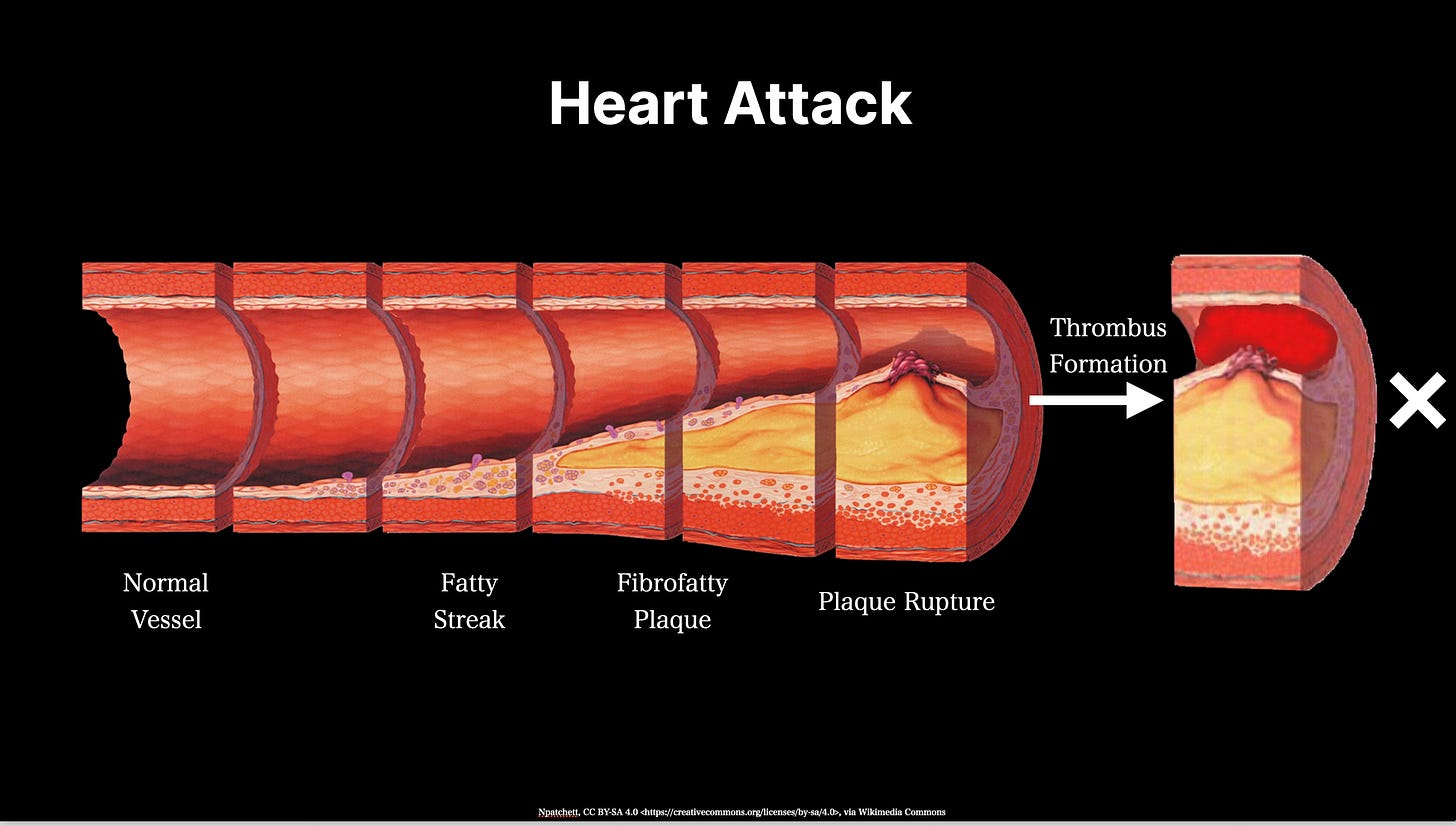
Heart disease is the presence of plaque or atherosclerosis in the coronary arteries.

(Heart disease can, of course, refer to many other heart-related conditions, but in general, the terms heart disease and coronary artery disease or atherosclerosis are typically used interchangeably)

A heart attack occurs when plaque ruptures in the artery, forming a clot that blocks blood flow down the artery, and the heart muscle dies.

from Pocket
via Did you enjoy this article? Then read the full version from the author’s website.

How can mixed reality drive more engagement in movement and fitness?

Fitness is one of the most robust categories under discussion, across Augmented Reality and Virtual Reality devices. For whom does this movement level merit the moniker “fitness”? And what timeline are we working with to see the sweeping adoption of fitness via spatial computing (the term widely known now due to Apple’s Vision Pro announcement and curving of the terms VR / AR / MR collectively)?

I’m seeing new unlocks particularly as it relates to the comfort of the device, spatial awareness afforded due to camera passthrough, and greater respect for ergonomic polish among developers.

The video seen here is a clip taken November 8th, 2023, showing a first-person view of a Quest 3 experience that allows for gestures, hand tracking, and movement to be used as input to an increasing number of games.

The title is built by YUR, the app name is YUR World.

Refuge

With violent conflicts all over the world in Palestine, Gaza, Ukraine, Myanmar, Chad, and many other places… the word refuge or sanctuary, was the center of Jack Kornfield’s Monday Dharma talk tonight.


What is your refuge? … What helps you forgive? … Take refuge in trust.

Jack Kornfield


Jack shared that the wisest of us look at the roots of suffering and the causes of conflict (for example, he mentioned cyclical, complex trauma). In light of this, when we haven’t unearthed the axioms of a situation we may find uncertainty and curiosity are valuable guiding traits. To represent this idea further see ‘taking a position’ not a ‘side’.

The Dharma then naturally veers towards the crucial role of community in today’s tumultuous times, especially in fostering peace and support. Somewhere you can feel safe.

In a grounded sense, this takes much less than you might think. A community can be just two people. I’ve seen that sending a simple text message saying “I’m sending you a big hug” to one of my really traumatized and grief-stricken Palestinian friends went a long way. In a sense, perhaps a litmus test of a community is a place where you are seen and heard by another person compassionately.

One poignant observation that was shared, particularly in the context of the conflict in Palestine, spotlighted the hurdle one faction faces in empathizing with the other, especially when their minds are clouded with their own distress. I think this is of critical importance for us to understand. When suffering, we all need to recognize that unconsciously we are likely to be less present to the experience of others.

Join a Monday Night Dharma Talk & Meditation with Jack Kornfield [Click here].

“Spirit Rock’s Monday Night Dharma Talk and Meditation program is open to all and meets every Monday night from 7:15 – 9:15 p.m. Jack Kornfield began this weekly practice and gathering over 36 years ago to introduce the practices of awareness and compassion.” 

Spirit Rock

“Don’t let the behavior of others destroy your inner peace.” – Dalai Lama

This entire post is scoped to discuss the primary definition of refuge, a physical space. However, there are also virtual and psychological kinds of refuge. The concept of refuge is helpful to those even without physical conflict perhaps those who are burned out, lonely, or struggling otherwise.

My Experience Working Out At-Home During the Global COVID-19 Outbreak

At first glance, this post might sound pedantic, for comprehensive info on the Corona Virus visit the WHO Q&As or CDC. This post is in regard to immunological fitness and how the virus is spread and my personal method of using virtual reality as an additional form of exercise:

The disease can spread from person to person through small droplets from
 the nose or mouth which are spread when a person with COVID-19 coughs or 
exhales. These droplets land on objects and surfaces around the person. 
Other people then catch COVID-19 by touching these objects or surfaces, 
then touching their eyes, nose or mouth


source: https://www.who.int/news-room/q-a-detail/q-a-coronaviruses

For the above reason, gyms and other typically crowded workout facilities are out. However, exercise is still a key part of staying healthy, more on this further down. I’ve been using an at-home workout strategy using virtual reality for over two weeks and I’d like to share why this is working for me.

TLDR

If you own a VR headset; some titles that could be used for cardio are:

- Beat Saber
- Box VR
- OhShape
- Thrill of the Fight
- Synth Riders
- Creed: Rise to Glory
- Until You Fall

Active titles that can be modified to be more of a workout:

- Rec Room
- RacketNX
- Pistol Whip
- Lone Echo
- Superhot VR

For general standing activity to afford you some low intensity movement:

- Racket Fury
- Sports Scramble
- VRChat

Virtual reality is a little known option for folks as it relates to fitness, but now we know at my company YUR that thousands of people use VR games daily to workout in a fun and efficient way. The big difference is that while wearing a VR headset you are completely immersed in playing the role of a player in a game. It’s important to note that this trend towards immersive fitness is visible with Peloton, Les Mills, and other fitness names.

YUR monthly view

My month so far has been characterized by workouts between 250 kcals and 750 kcals as you can see, every day (except for March 4th). I’ll tend to use games such as Box VR or Beat Saber, and with YUR the cool part about this is any game can be played and tracked which allows for constant novelty the moment you feel bored of your current exercise regime. This doubles as a benefit if you are feeling cooped up at home.

… with YUR any game can be played and tracked which allows for constant novelty the moment you feel bored of your current exercise regime

I would characterize the kind of workouts I do in VR as plyometric, and explosive in nature similar to a HIIT workout. However, this is up to your personal preference.

As a perennial gym-goer, I have to point out here what VR workouts are not providing me and others. Hypertrophic or strength benefits from lifting weights, cycling, rowing, calisthenics, and running are all different from VR workouts.

So how does staying immunologically fit factor into this as well as COVID-19? I’m not posing a risk to others (as long as I am the only one using my VR headset). By doing this I’m participating in a community.

To be immunologically fit, you need to be physically fit. “White blood 
cells can be quite sedentary,” says Akbar. “Exercise mobilises them by increasing your blood flow, so they can do their surveillance jobs and seek
 and destroy in other parts of the body.” The NHS says adults should be 
physically active in some way every day, and do at least 150 minutes a week 
of moderate aerobic activity (hiking, gardening, cycling) or 75 minutes of 
vigorous activity (running, swimming fast, an aerobics class).

`source: https://www.theguardian.com/lifeandstyle/2020/mar/08/how-to-boost-your-immune-system-to-avoid-colds-and-coronavirus`

So basically, in the middle of my day between 1 pm or 6 pm, I throw my Oculus Quest on and workout for maybe half an hour or so. I hope that this has been insightful to you and if you have a VR headset perhaps this can factor into your virus response.

This post initially appeared on my Linkedin.

Reblog: The Mind-Expanding Ideas of Andy Clark

The idea of the extended mind or extended cognition is not part of common parlance; however, many of us have espoused this idea naturally since our youth. It’s the concept that we use external, physical or digital, information to extend our knowledge and thinking processes.

Today’s “born-digital” kids––the first generation to grow up with the Internet, born 1990 and later––store their thoughts, education, and self-dialogue in external notes saved to the cloud. [1]

“… [Andy Clark describes us as] cyborgs, in the most natural way. Without the stimulus of the world, an infant could not learn to hear or see, and a brain develops and rewires itself in response to its environment throughout its life.”

via Read the full version from the author’s website.

[1] McGonigal; “Reality is Broken” pg. 127

Games as Medicine | FDA Clearance Methods


Games as Medicine | FDA Clearance Methods

Noah Falstein, @nfalstein
President, The Inspiracy
Neurogaming Consultant

Technically software and games are cleared and not approved by the FDA.

By background, Noah:

  • Has attended 31 GDCs
  • Been working in games since 1980 (started in entertainment and arcade games with Lucas Entertainment)
  • Gradually shifted over and consulted for 17 years on a wide variety of games
  • Started getting interested in medical games in 1991 (i.e. East3)
  • Went to Google and left due to platform perspective one had to have at Google
  • Game designer not a doctor, but voraciously learns about science and medical topics

Table of Content:

  • Context of games for health
  • New factor of FDA clearance
  • Deeper dive
  • Adv. and Disadvan. to clearance

Why are games and health an interesting thing?

Three reasons why games for health are growing quickly and are poised to be a very important thing

  • It’s about helping people (i.e. Dr. Sam Rodriguez’s work Google “Rodriguez pain VR”)
  • It’s challenging, exciting, and more diverse than standard games (i.e. games need to be fun, but if they’re not having the desired effect, for example restoring motion after a stroke, then you encounter an interesting challenge). The people in the medical field tend to be more diverse than those in the gaming space.
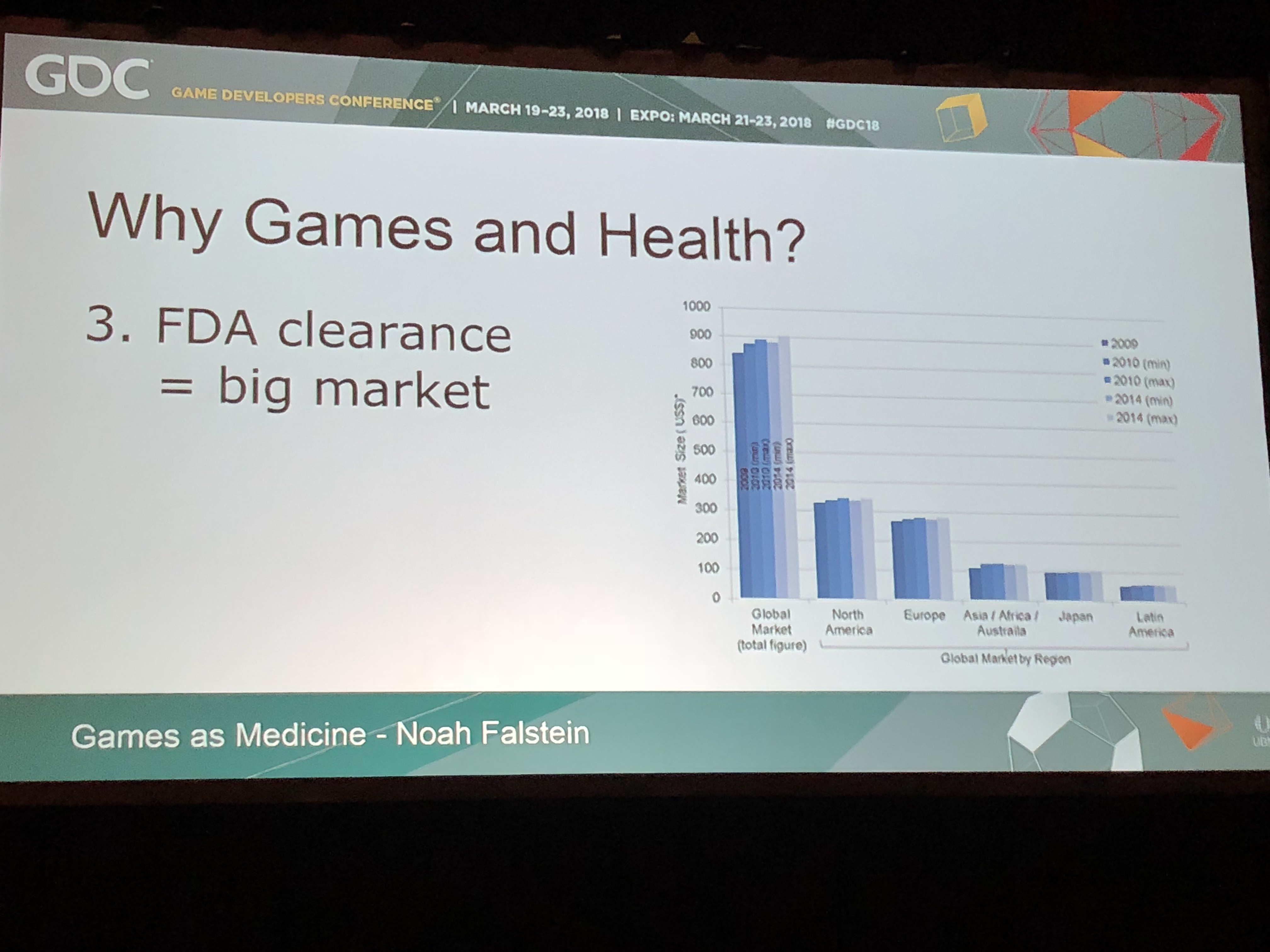
  • It’s a huge market* FDA clearance = big market
    IMG_2271

So what’s the catch?

Mis-steps along the way

  • Brain Training (i.e. Nintendo Gameboy had popular Japanese games claiming brain training)
  • Wii Fit (+U) (i.e. the balance board)
  • Lumosity fine (i.e. claims made that were unsubstantiated by research)

upshot: lack of research and good studies underpinning claims

Some bright spots

  • Remission from Hopelab (i.e. they targeted adherence: using the consequences of not having enough chemotherapy in their body)

FDA clearance is a gold standard

  • Because it provides a stamp of good, trustable, etc.
  • The burden is on the people who make products to go through a regimen of tests that are science-driven
  • Noah strongly recommends Game Devs to link up with a university
  • Working on SaMD – Software as a Med Device
  • Biggest single world market drives others
  • Necessary for a prescription and helps with insurance reimbursement
  • but it’s very expensive and time-consuming

IMG_2272

FDA definition of a serious disease
[missing]

MindMaze Pro

  • FDA clearance May 2017
  • Stroke Rehabilitation
  • Early in-hospital acute care while plasticity high

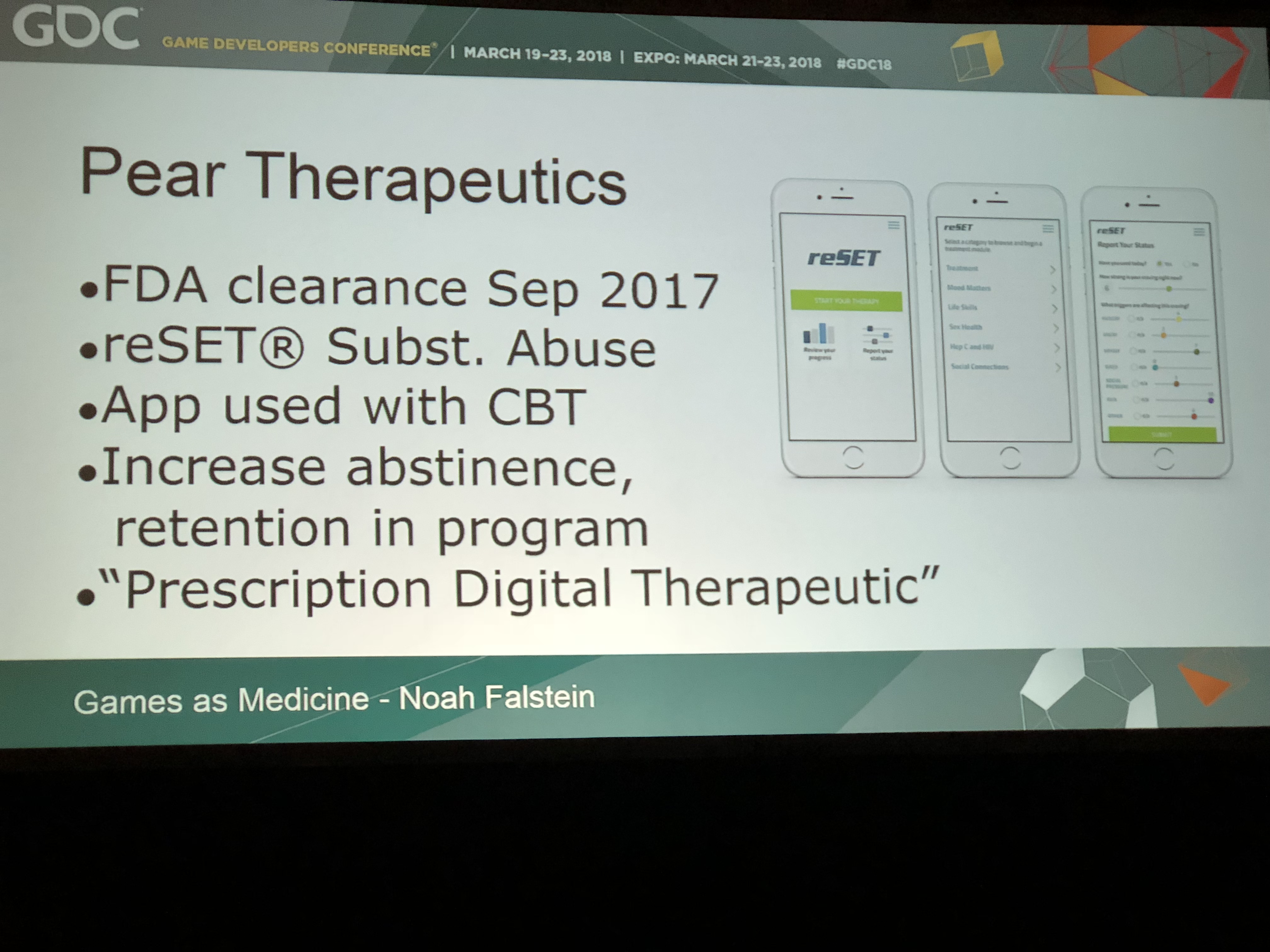
Pear Therapeutic

  • Positions its product as a “prescription digital therapeutic”

IMG_2273

Akili Interactive Labs

  • Treats pediatric ADHD
  • Late-stage trial results (Dec. 2017) were very positive with side effects of a headache and frustration, which is much better than alternatives like Ritalin
  • Seeking De Novo clearance
  • Adam Gazzaley – began as aging adult research with Neuroracer, a multi-year study published in Nature

The Future – Good, Bad, Ugly, Sublime

  • Each successful FDA clearance helps
  • But they still will require big $, years to dev
  • you have to create a company, rigorously study it, stall production because changing your game
    would make results invalid from studies, then you need to release it
  • Pharma is a powerful but daunting partner

Questions

  • Can FDA certification for games then reveal that some games are essentially street drugs?