The idea of the extended mind or extended cognition is not part of common parlance; however, many of us have espoused this idea naturally since our youth. It’s the concept that we use external, physical or digital, information to extend our knowledge and thinking processes.
Today’s “born-digital” kids––the first generation to grow up with the Internet, born 1990 and later––store their thoughts, education, and self-dialogue in external notes saved to the cloud. [1]
“… [Andy Clark describes us as] cyborgs, in the most natural way. Without the stimulus of the world, an infant could not learn to hear or see, and a brain develops and rewires itself in response to its environment throughout its life.”
Noah Falstein, @nfalstein
President, The Inspiracy
Neurogaming Consultant
Technically software and games are cleared and not approved by the FDA.
By background, Noah:
Has attended 31 GDCs
Been working in games since 1980 (started in entertainment and arcade games with Lucas Entertainment)
Gradually shifted over and consulted for 17 years on a wide variety of games
Started getting interested in medical games in 1991 (i.e. East3)
Went to Google and left due to platform perspective one had to have at Google
Game designer not a doctor, but voraciously learns about science and medical topics
Table of Content:
Context of games for health
New factor of FDA clearance
Deeper dive
Adv. and Disadvan. to clearance
Why are games and health an interesting thing?
Three reasons why games for health are growing quickly and are poised to be a very important thing
It’s about helping people (i.e. Dr. Sam Rodriguez’s work Google “Rodriguez pain VR”)
It’s challenging, exciting, and more diverse than standard games (i.e. games need to be fun, but if they’re not having the desired effect, for example restoring motion after a stroke, then you encounter an interesting challenge). The people in the medical field tend to be more diverse than those in the gaming space.
It’s a huge market* FDA clearance = big market
So what’s the catch?
Mis-steps along the way
Brain Training (i.e. Nintendo Gameboy had popular Japanese games claiming brain training)
Wii Fit (+U) (i.e. the balance board)
Lumosity fine (i.e. claims made that were unsubstantiated by research)
upshot: lack of research and good studies underpinning claims
Some bright spots
Remission from Hopelab (i.e. they targeted adherence: using the consequences of not having enough chemotherapy in their body)
FDA clearance is a gold standard
Because it provides a stamp of good, trustable, etc.
The burden is on the people who make products to go through a regimen of tests that are science-driven
Noah strongly recommends Game Devs to link up with a university
Working on SaMD – Software as a Med Device
Biggest single world market drives others
Necessary for a prescription and helps with insurance reimbursement
but it’s very expensive and time-consuming
FDA definition of a serious disease
[missing]
MindMaze Pro
FDA clearance May 2017
Stroke Rehabilitation
Early in-hospital acute care while plasticity high
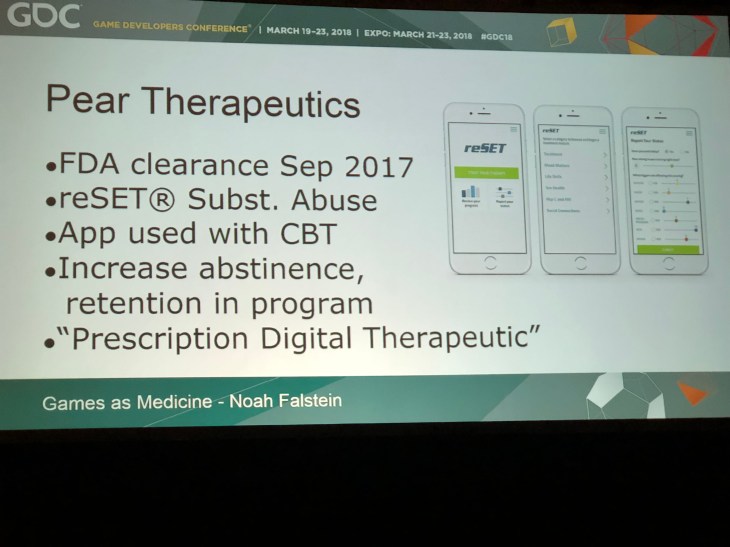
Pear Therapeutic
Positions its product as a “prescription digital therapeutic”
Akili Interactive Labs
Treats pediatric ADHD
Late-stage trial results (Dec. 2017) were very positive with side effects of a headache and frustration, which is much better than alternatives like Ritalin
Seeking De Novo clearance
Adam Gazzaley – began as aging adult research with Neuroracer, a multi-year study published in Nature
The Future – Good, Bad, Ugly, Sublime
Each successful FDA clearance helps
But they still will require big $, years to dev
you have to create a company, rigorously study it, stall production because changing your game
would make results invalid from studies, then you need to release it
Pharma is a powerful but daunting partner
Questions
Can FDA certification for games then reveal that some games are essentially street drugs?
Founded in 2000
Partnered with Quanta Computer (going to produce the optics engine),
Flex (OEM using Lumus reference), and Deepoptics (vergence accommodation)
Transaction expenses are high (syncing, VR transactions need to happen quickly,
must pay gas) Federated Consensus – near-zero transaction fees, etc.
Bad Monetary Policy
Bitcoin for being usable as a currency isn’t viable. Because Bitcoin is going up in
price so much and it’s fixed in circulation.
Increase circulation as people join
Second Life – made more money at roughly the same rate that people come online
Use a smart contract to create an exchange rate scaling
High Fidelity Coin (HFC)
Stable
Blockchain cryptocurrency
Easy to use, initial grants for proof-of-identity, and multiple currency exchange
Philip waxing about tech, says something to the effect of “with any big shift in technology
what often comes as compelling is things that are currently done in the world i.e. payment”
Philip also mentioned via s-contracts allowing duels to occur for identity
Cymatic-Bruce
Currently at 6D.AI
Came back from Japan
Saw so many vr experiences, met a ton of the community, discovered VTubing which
can also be found through IMVU, etc.
Learned a lot and PC VR isn’t a thing with Japan due to space and culture
PSVR location based VR situation
VR Zone Shinjuku-–world class location based experience. Tickets range from $10-15 per experience.
They take first-timers very seriously and interestingly take matters of safety really seriously.
Bruce really admired the standard of using motion platforms for everything, tie everything into an
IP, and did a great job of executing. Looks like he did a DBZ experience, and learned how to shoot a
Kamehamehameha. Mario Kart––on a motion platform, etc.
How long is the experience?
How much of what you saw in Japan will likely have an audience in EN?
How is FOVE doing?
VR experiences dealing with food?
Shiva Rajaraman has a long record building amazing products across YouTube, Google and now Spotify and joined us at Mind the Product in London to share some of the lessons he’s learned along the way.
The above work comes from Thomas Bedenk, who I met at VRX London in 2016. See end his page for sources (link found at bottom).
This model provides a substrate, an interactive application namely a game and its production and consumption, and highlights the aspects regarding components Player, Game, and Designer into the full picture.
Most VR experiences so far have been games and 360-degree videos, but Google is exploring the idea that VR can be a way to learn real life skills. The skill it chose to use as a test of this hypothesis is making coffee. So of course, it created a coffee making simulator in VR.
As explained by author, Ryan Whitwam, this simulation proved more effective over the other group in the study that had just a video primer on the coffee-making technique herein.
Participants were allowed to watch the video or do the VR simulation as many times as they wanted, and then the test—they had to make real espresso. According to Google, the people who used the VR simulator learned faster and better, needing less time to get confident enough to do the real thing and making fewer mistakes when they did.
As you all know, I have the Future of Farming project going right now with Oculus Launch Pad. It is my ambition to impart some knowledge about farming/gardening to users of that experience. Therefore I found this article to be quite intriguing. How fast can we all learn to crop tend using novel equipment should we be primed first by an interactive experience/tutorial. This is what I’d name ‘environment transferable learning’ or ETL. The idea that in one environment you can learn core concepts or skills that transcend the tactical elements of the environment. For example, a skill learned in VR that translates into a real world environment, maybe “Environment Transferable Skills” or ETS.
A fantastic alternate example, also comes from Google, with Google Blocks. This application allows Oculus Rift or HTC Vive users to craft 3D models with controllers, and the tutorial walks users through how to use their virtual apparatuses. This example doesn’t use ETL, but we can learn from the design of the tutorial nonetheless for ETL applications. For instance, when Blocks teaches how to use the 3D shape tool it focuses on teaching the user by showing outlines of 3D models that it wants the user to place. The correct button is colored differently relative to other touch controller buttons. This signals a constraint to the user that this is the button to use. With sensors found in the Oculus Touch controllers, one could force the constraint of pointing with the index finger or grasping. In the example of farming, if there is a button interface in both the real and virtual world (the latter modeled closely to mimic the real world) I can then show a user how to push the correct buttons on the equipment to get started.
What I want to highlight is that it’s kind of a re-engineering of having someone walk you through your first time exercising a skill (i.e. espresso-making). It’s cool that the tutorial can animate a sign pointing your hands to the correct locations etc. Maybe not super useful for complicated tasks but to kind of instruct anything that requires basic motor skills VR ETL can be very interesting.
Practicing paying attention can boost performance on a new task, and change the way the brain processes information, a new study says.
In my first blog post on the Oculus forums, I write:
“Boiling things down, I realized a few tenets of virtual reality to highlight 1) is that one is cut off from the real world if settings are in accordance (i.e. no mobile phone notifications) and therefore undivided attention is made. 2) Immersion and presence can help us condense fact from the vapor of nuance. The nuance being all of the visual information you will automatically gather from looking around that you would otherwise not necessarily have with i.e. a textbook.”
What would you leverage VR’s innate ability to funnel our attention and focus for?
S.L. Benfica—Portugal’s top football team and one of the best teams in the world—makes as much money from carefully nurturing, training, and selling players as actually playing football.
Football teams have always sold and traded players, of course, but Sport Lisboa e Benfica has turned it into an art form: buying young talent; using advanced technology, data science, and training to improve their health and performance; and then selling them for tens of millions of pounds—sometimes as much as 10 or 20 times the original fee.
Let me give you a few examples. Benfica signed 17-year-old Jan Oblak in 2010 for €1.7 million; in 2014, as he blossomed into one of the best goalies in the world, Atlético Madrid picked him up for a cool €16 million. In 2007 David Luiz joined Benfica for €1.5 million; just four years later, Luiz was traded to Chelsea for €25 million and player Nemanja Matic. Then, three years after that, Matic returned to Chelsea for another €25 million. All told, S.L. Benfica raised more than £270 million (€320m) from player transfers over the last six years.
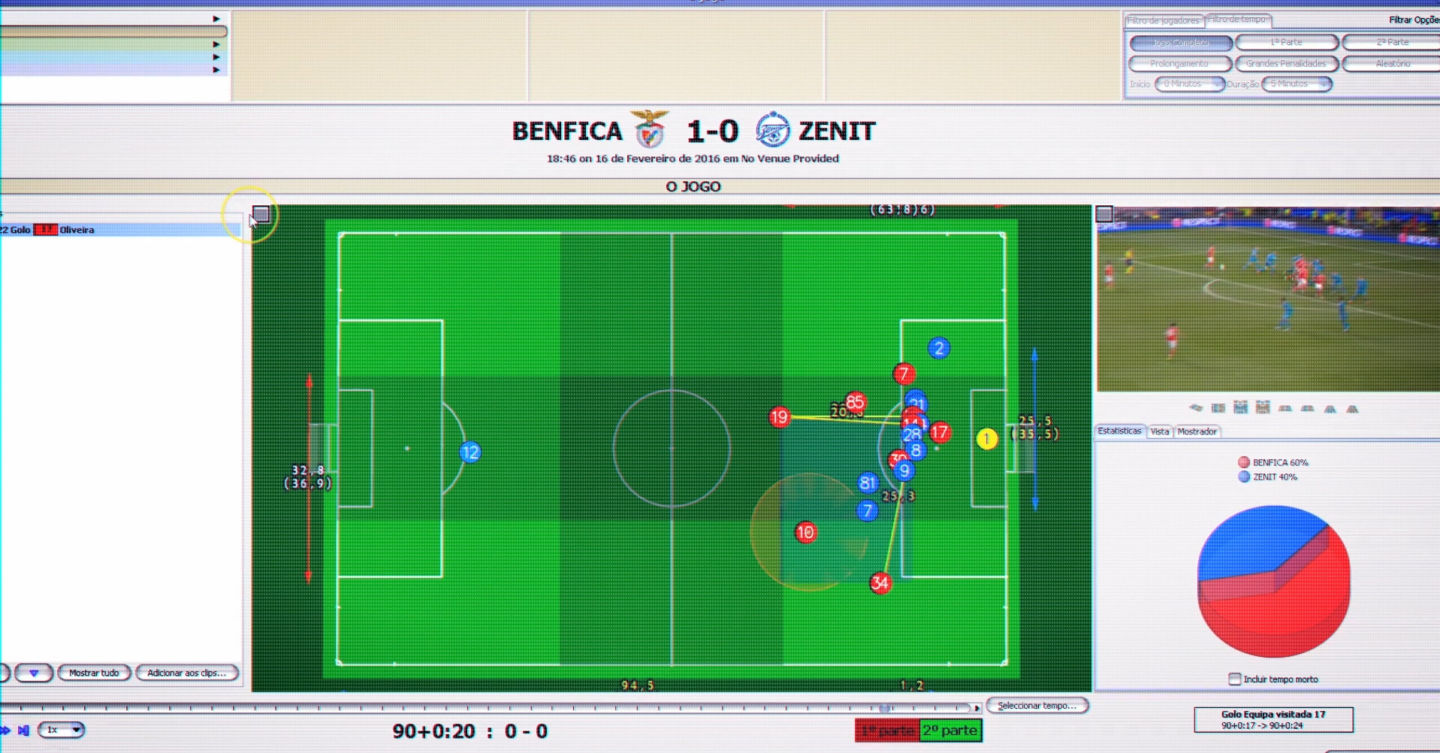
At Benfica’s Caixa Futebol Campus there are seven grass pitches, two artificial fields, an indoor test lab, and accommodation for 65 youth team members. With three top-level football teams (SL Benfica, SL Benfica B, and SL Benfica Juniors) and other youth levels below that, there are over 100 players actively training at the campus—and almost every aspect of their lives is tracked, analyzed, and improved by technology. How much they eat and sleep, how fast they run, tire, and recover, their mental health—everything is ingested into a giant data lake.
With machine learning and predictive analytics running on Microsoft Azure, combined with Benfica’s expert data scientists and the learned experience of the trainers, each player receives a personalized training regime where weaknesses are ironed out, strengths enhanced, and the chance of injury significantly reduced.
Sensors, lots of sensors
Before any kind of analysis can occur, Benfica has to gather lots and lots of data—mostly from sensors, but some data points (psychology, diet) have to be surveyed manually. Because small, low-power sensors are a relatively new area with lots of competition, there’s very little standardization to speak of: every sensor (or sensor system) uses its own wireless protocol or file format. “Hundreds of thousands” of data points are collected from a single match or training session.
Processing all of that data wouldn’t be so bad if there were just three or four different sensors, but we counted almost a dozen disparate systems—Datatrax for match day tracking, Prozone, Philips Actiware biosensors, StatSports GPS tracking, OptoGait gait analysis, Biodex physiotherapy machines, the list goes on—and each one outputs data in a different format, or has to be connected to its own proprietary base station.
Benfica uses a custom middleware layer that sanitises the output from each sensor into a single format (yes, XKCD 927 is in full force here). The sanitised data is then ingested into a giant SQL data lake hosted on the team’s own data centre. There might even be
a few Excel spreadsheets along the way, Benfica’s chief information officer Joao Copeto tells Ars—”they exist in every club,” he says with a laugh—but they are in the process of moving everything to the cloud with Dynamics 365 and Microsoft Azure.
Once everything is floating around in the data lake, maintaining the security and privacy of that data is very important. “Access to the data is segregated, to protect confidentiality,” says Copeto. “Detailed information is only available to a very restricted group of professionals.” Benfica’s data scientists, which are mostly interested in patterns in the data, only have access to anonymised player data—they can see the player’s position, but not much else.
Players have full access to their own data, which they can compare to team or position averages, to see how they’re doing in the grand scheme of things. Benfica is very careful to comply with existing EU data protection laws and is ready to embrace the even-more-stringent General Data Protection Regulation (GPDR) when it comes into force in 2018.
Project Tango has been around for a while, from the developer tablet and demos at MWC and Google I/O to the Lenovo Phab2 Pro and the new Asus Zenfone AR. While we’ve seen it progress quite steadily in that time, we’ve never seen it look as convincing as it did at I/O this week.










 The Latent Element